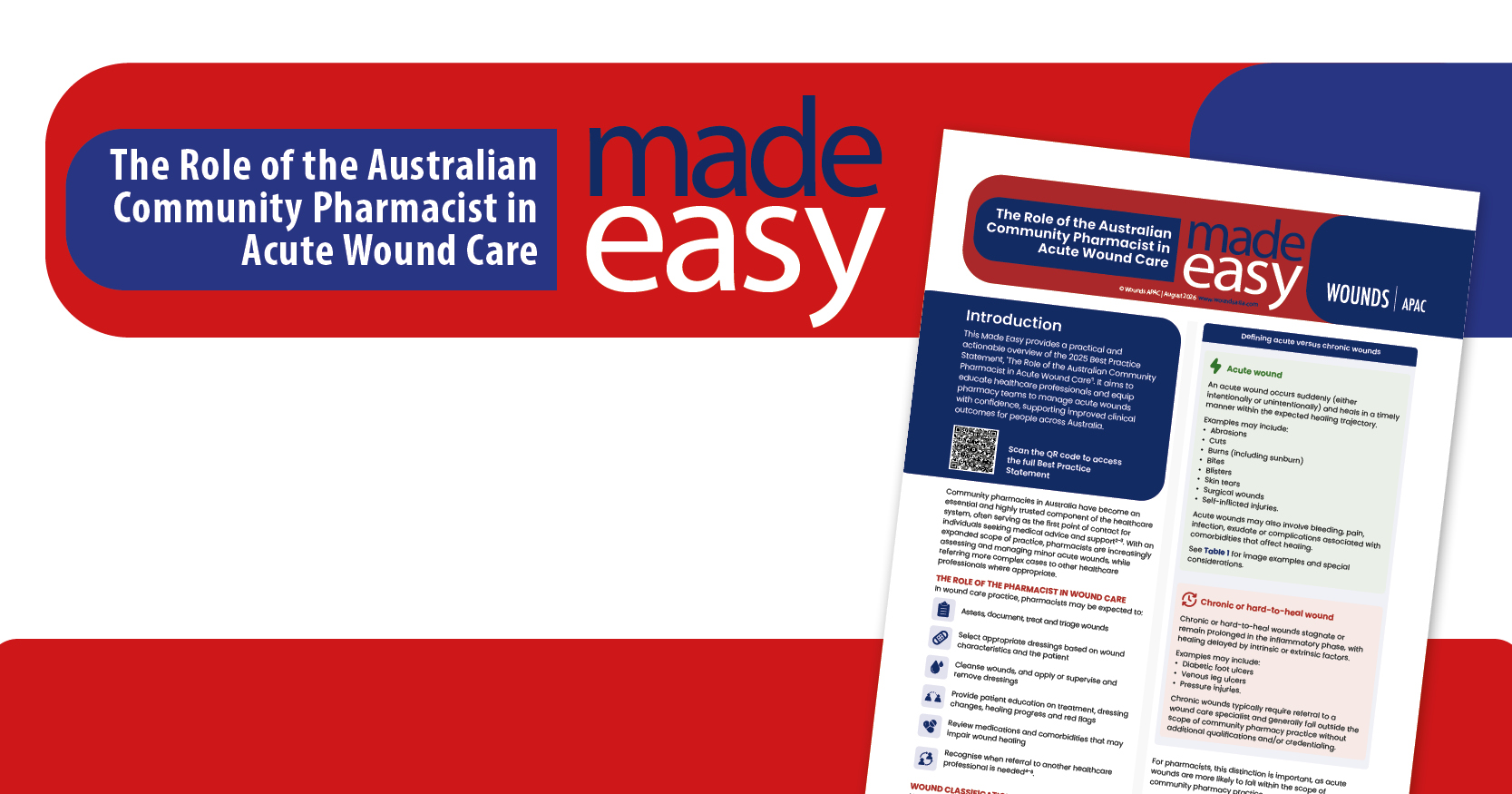
Community pharmacies in Australia have become an essential and highly trusted component of the healthcare system, often serving as the first point of contact for individuals seeking medical advice and support2–3. With an expanded scope of practice, pharmacists are increasingly assessing and managing minor acute wounds, while referring more complex cases to other healthcare professionals where appropriate.
The role of the pharmacist in Wound care
In wound care practice, pharmacists may be expected to:
- Assess, document, treat and triage wounds
- Select appropriate dressings based on wound characteristics and the patient
- Cleanse wounds, and apply or supervise and remove dressings
- Provide patient education on treatment, dressing changes, healing progress and red flags
- Review medications and comorbidities that may impair wound healing
- Recognise when referral to another healthcare professional is needed4–6.
Wound Classification
Understanding wound type guides the pharmacist’s management approach and helps identify when referral is needed.
Wounds can generally be classified as either acute or chronic (otherwise known as hard-to-heal).
For pharmacists, this distinction is important, as acute wounds are more likely to fall within the scope of community pharmacy practice.
The importance of wound assessment
Thorough assessment is the first step in successful wound management.
A structured approach to assessment supports clinical decision-making and appropriate referral. A practical framework for assessing acute wounds includes three key components: history taking, visual and physical examination and functional assessment [Figure 1].
The TIME(S) Framework
Although developed for chronic wounds, the TIME(S)framework8 [Table 2] remains a practical guide for observing and describing acute wounds and identifying potential complications or delayed healing.
Identifying infection
Although infection and inflammation share clinical features, assessment of signs, symptoms, timing, wound appearance, microbiological findings, response to treatment and clinical judgement can help differentiate between them and guide management. See Box 1 for clinical signs and symptoms of infection.
Tetanus reminder
- Any acute wound, including small cuts, punctures and animal bites, may be tetanus-prone
- Always triage for tetanus risk and review vaccination status to guide management.
Antimicrobial Stewardship (AMS)
Most wounds do not require antibiotics; antiseptics and appropriate dressings are usually sufficient. Antibiotics should only be used as per local guidelines when there is clear evidence of infection. Inflamed but non-infected wounds may respond to cleansing, debridement and topical anti-inflammatory therapies9.
Given the global concern regarding antibiotic resistance, topical antibiotics should only be used in infected wounds under specific circumstances and by experienced clinicians10–12. Topical antimicrobials or antimicrobial dressings are not required without clinical signs of infection, unless used prophylactically in at-risk wounds or individuals13.
Medications That may Impair Wound Healing
As a pharmacist, reviewing medication history is one of the most valuable contributions to wound care. Pharmacists should always obtain a comprehensive history, including prescribed, over-the-counter and complementary medicines. See Table 3 for examples of medication classes commonly associated with impaired wound healing14.
Wound cleansing
According to the International Wound Infection Institute, a wound dressing involves cleansing, debridement, wound assessment and application of a new dressing to protect the wound, promote healing and manage or prevent infection. Wound cleansing solutions have different purposes and properties15:
- Clean wounds typically do not require antiseptics. Cleansing with water and a suitable surfactant is usually sufficient
- Antiseptics (e.g. hypochlorous acid, octenidine dihydrochloride [OCT], polyhexamethylene biguanide [PHMB]) are effective in preventing and managing wound infections and biofilms, particularly when used in combination with debridement and antimicrobial dressings.
The importance of undisturbed wound healing
An important goal in acute wound management is to minimise unnecessary disturbance to the wound site. Known as ‘undisturbed wound healing’, this involves leaving a dressing in place for as long as clinically appropriate. Dressing wear time may be extended to 5–7 days, depending on the wound, individual and dressing type16. This approach is not appropriate if exudate causes strikethrough or leakage, frequent wound inspection is required (e.g. post-operative wounds with signs of infection), the dressing becomes detached or maceration develops.
Dressing management and patient education Pharmacists play a key role in educating individuals on the safe use of dressings between clinical visits. As most acute wounds are eventually managed by individuals or carers, understanding when a dressing needs changing [Box 2], as well as correct dressing application and removal [Box 3], is essential.
For a summary of dressing properties, indications and precautions7, see Table 4.
Knowing when to refer
Referral should be guided by scope of practice, clinical judgement and local protocols.
Factors prompting referral may include:
- Size, depth or location of the wound (e.g. face, joints, hands)
- Cause (e.g. chemical or electrical burns, animal bites)
- Severity
- Age of the individual
- Presence/signs of infection.
Suitable referrals may be to general practitioners, wound care clinicians, podiatrists, dermatologists, surgeons or emergency services. Specific referral triggers for each wound type are also noted in Table 1.
Access the associated Best Practice Statement here.