
The global prevalence of chronic wounds is estimated at 1.51–2.21 per 1,000 people (Martinengo et al, 2019). A recent meta-analysis by Burhan et al (2025) indicated that the prevalence of chronic wounds in Asian populations is 32.1%. This incidence is likely to increase due to a global shift towards ageing populations, in tandem with the rising burden of non-communicable diseases such as diabetes and vascular disorders, which may have contributed to the rise in chronic wounds (World Health Organization, 2025). Failure of wound closure within normal healing timelines, along with the high recurrence rates of chronic wounds, impacts not only society, but also individual well-being. A 2019 systematic review revealed that patients with chronic wounds frequently reported lower health-related quality of life in the domains related to physical functioning (Olsson et al, 2019).
Chronicity and hard-to-heal wounds are attributed to various interwoven factors, including those related to the patient, the wound, healthcare professionals’ skill and management (European Wound Management Association, 2008). However, a common pathogenic feature is the disruption of the extracellular matrix (ECM) due to elevated matrix metalloproteinases (MMPs), such as proteases, leading to impaired fibroblast and keratinocyte activity (Eming et al, 2014). When this process of inflammation is prolonged, it leads to delayed wound healing. To counteract this problem, wound care products that can modulate MMPs and promote the laying down of ECM to support wound healing will be beneficial.
One of the major components of the ECM is collagen. Collagen, the dominant structural protein in the human body (up to 30% of total body protein), has been incorporated into a multitude of medical devices designed for wound healing, tissue regeneration and skin care (Amirrah et al, 2022). Collagen can easily be isolated from animals (porcine, bovine, equine, avian), plant, and marine sources, as well as produced synthetically in a laboratory or as a recombinant protein (Silvipriya et al, 2015). The abundant accessibility and ease of use in clinical applications have led to a global market of patient-accessible products that promote positive healing outcomes compared with more traditional approaches.
In the cascade of wound healing, collagen is a crucial component in all stages. In haemostasis, platelets interact with extravascular collagen to initiate thrombosis (Navarro et al, 2021). Additionally, collagen degradation releases soluble fragments as a chemoattractant for recruitment of immune cells such as neutrophils and macrophages (Kisling et al, 2019). In the proliferation phase, collagens promote migration of epidermal keratinocytes during wound healing. Guo et al (1990) demonstrated that type I collagen is one of the factors that induces activation of human keratinocyte cells in vitro. Collagen influences ECM remodelling and influences angiogenesis through specific integrin receptors (Kisling et al, 2019). As the wound heals, collagen reorganisation strengthens the tissue by substituting disorganised type III fibres with cross-linked type I fibres, resulting in a less elastic scar (Gurtner et al, 2008).
Methods
This is a descriptive case series evaluating clinical responses to a collagen-based wound dressing (Colmedra by Winner Medical) in patients managed at a tertiary wound care clinic. A total of nine patients were selected through convenience sampling based on their follow-up at the clinic. Patients enrolled had chronic or complex wounds that had persisted for at least 12 weeks, representing a population group with delayed or impaired healing processes. Wound types comprised diabetic foot ulcers (n=3), venous leg ulcers (n=1), necrotising fasciitis post-debridement (n=3), post-traumatic wounds (n=1) and carbuncle post-saucerisation (n=1). All patients had at least one significant comorbidity, such as diabetes, hypertension, peripheral vascular disease or chronic kidney disease, factors known to affect wound healing. Prior to commencement of treatment, each patient was evaluated to ensure suitability for collagen dressing application. Only wounds that were clean, non-infected and had normal perfusion or a normal ankle–brachial Index (ABI), were included to eliminate the confounding effects of active infection or substantial ischaemia.
Each patient received the same standard of care during this period. Cleansing was done with sterile water, followed by debridement if indicated. Colmedra collagen sheet was applied directly to the wound bed after adequate wound bed preparation. A secondary dressing of non-adherent, absorbent dressing was chosen according to the wound’s exudate levels. Dressings were generally changed every two to three days. Offloading of plantar ulcers and compression therapy were included as part of the standard of care. Continuous wound assessment with the TIME framework was used to direct the dressing and frequency of patient review. All patients were subjected to the same structured protocol and documentation during follow-up. Wound area was calculated as length × width (cm²). Percentage wound area reduction was determined using: [(initial wound area − endpoint wound area) / initial wound area] × 100%. The primary outcome measure was percentage reduction in wound size at 12 weeks, calculated by comparing the wound dimension at baseline (week 1). Secondary clinical observations were the occurrence of local adverse reactions and signs of infection. Written consent for wound photography and clinical documentation was obtained from all patients. As a descriptive case series, ethical approval was not required according to local guidelines.
Results
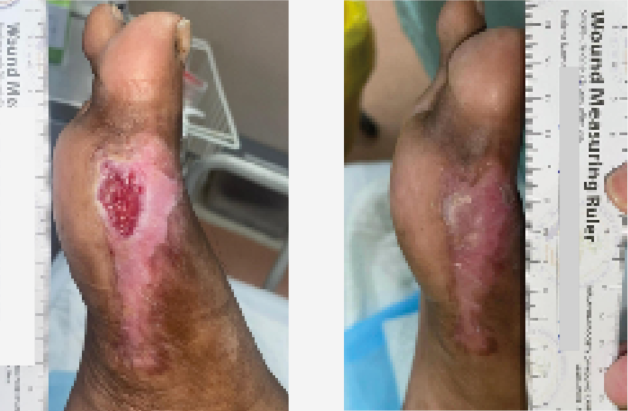
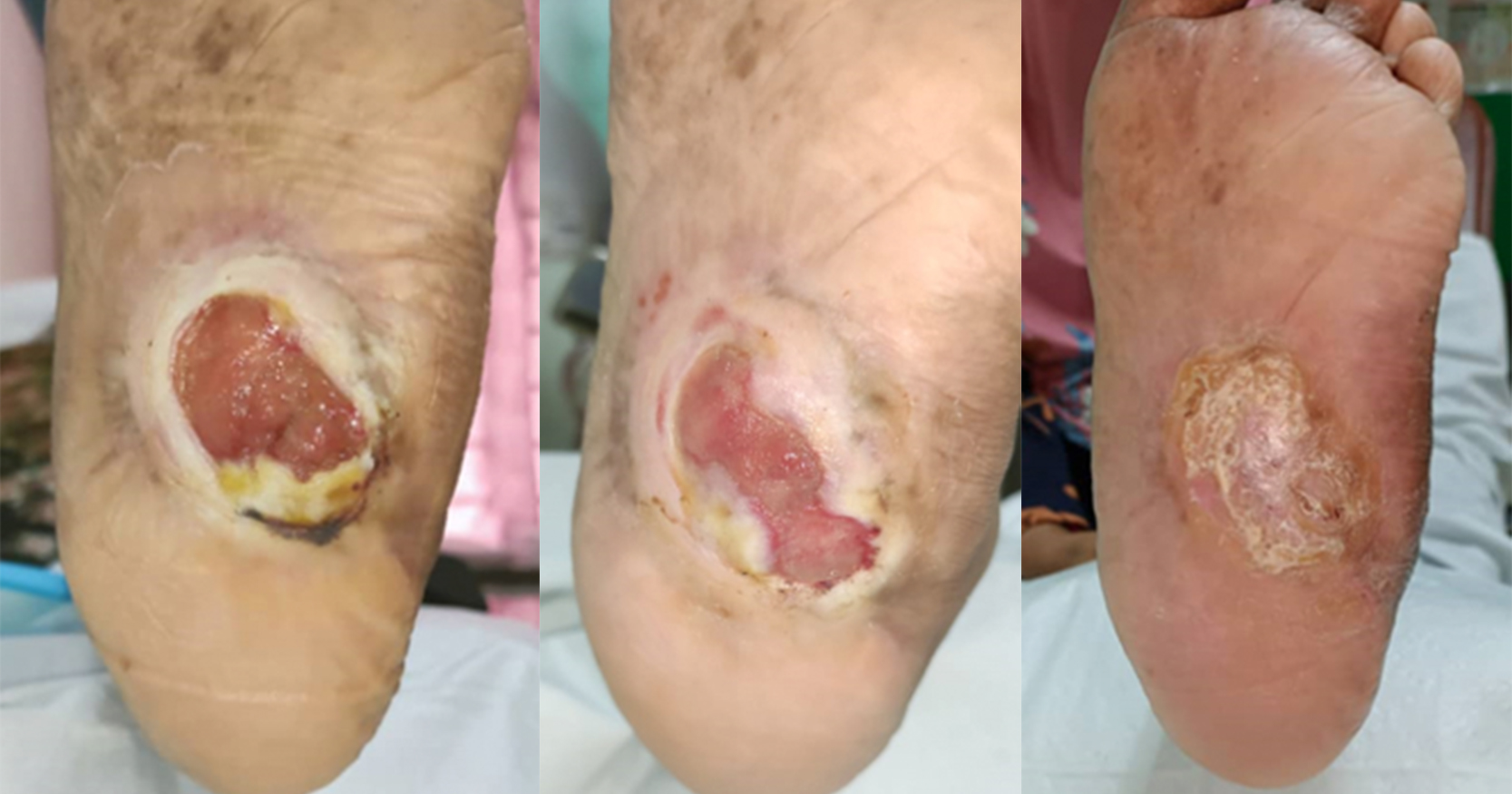
The patient characteristics and results are shown in Table 1. The progression of the individual cases is shown in Figures 1–9.
Discussion
In the nine cases observed, consistent progressive improvement of wounds was documented from baseline to week 12. Early wound responses were noted within the first 3–4 weeks, marked by the appearance of healthy granulation tissue and a decrease in non-viable tissue. By week 6, most wounds had well-vascularised granulation tissue, with decreasing slough and reduced exudate levels, indicating a shift from the inflammatory phase to the proliferative phase. No cases exhibited clinical signs of infection during the treatment period and there were no reports of localised adverse effects, including maceration, dermatitis or sensitivity to the collagen matrix. Wound size assessments indicated reductions of 43% to 89% by week 12, with diabetic foot ulcers exhibiting the most significant wound contraction. Post-debridement wounds (necrotising fasciitis and carbuncle) had consistent granulation and re-epithelialisation, but the venous leg ulcer in case 3 revealed a slower response, likely due to irreversible changes in the skin and subcutaneous tissue from advanced chronic venous insufficiency.
This case series shows the efficacy of bovine collagen-based dressings in facilitating the progression and healing of various chronic and hard-to-heal wounds. A key mechanism underlying these outcomes is collagen’s ability to modulate MMPs. Chronic wounds often reflect an imbalance between proteases and their inhibitors, leading to the excessive degradation of the native extracellular matrix and growth factors. Collagen dressings serve as “sacrificial substrates,” drawing proteolytic activity away from host tissue (Chaby et al, 2007). This series reveals that clinical observations of reduced slough, improved moisture balance and advancing granulation tissue after many weeks of treatment correspond to successful protease regulation. Khatoon et al (2024) similarly emphasise collagen’s role in modulating protease imbalance and promoting angiogenesis, reporting consistent improvements in DFU closure rates across diverse biomaterial formats, further reinforcing the clinical relevance of our findings. The recent development of DFU-specific collagen–oxidised regenerated cellulose (ORC) dressings by Theodorakopoulos and Armstrong (2025) reinforces the findings. Their systematic review and meta-analysis of randomised controlled trials revealed that collagen-ORC combinations enhanced full healing relative to standard treatment, partly due to superior protease modulation and stabilisation of the ECM.
The most favourable results observed in this case series were in diabetic foot ulcers (up to 89% reduction in size) and can be attributed to the synergistic effects of collagen scaffolding and simultaneous unloading, highlighting the necessity of combining advanced dressings with adjunctive therapy. These findings are generally consistent with higher-level evidence from randomised trials and meta-analyses for collagen dressings in diabetic foot ulcers (DFUs) and other chronic wounds.
Shu et al’s meta-analysis of 11 randomised controlled trials including 961 patients revealed that the incorporation of a collagen dressing into standard care significantly enhanced complete healing rates (53.4% versus 34.5%; RR 1.53, 95% CI [1.33–1.77]) and expedited healing rates (Shu et al, 2022). In our series, while complete closure was not the primary endpoint, the extent of area reduction (up to 89% in DFU) is favourable when compared to the healing trajectories shown in these controlled studies, underscoring collagen’s potential as an effective supplementary therapy.
The venous leg ulcer case had a relatively slower response (43% reduction at 12 weeks), in contrast to more rapid healing observed in DFUs and post-debridement necrotising fasciitis wounds. This divergence likely indicates the advanced and structurally irreversible characteristics of chronic venous disease in that patient, emphasising that compression therapy and rectification of underlying venous pathology are indispensable, with collagen acting as a supportive adjunct rather than an independent solution. Shu et al (2022) found that healing velocities for chronic wounds varied between 4% and 10% per week, with a mean velocity of 5.8% per week in this cohort aligning well with established ranges. The VLU healing rate of 3.6% per week is consistent with existing evidence indicating that venous ulcers heal at a slower pace than diabetic foot ulcers, even with collagen dressing (Shi et al, 2023).
Despite positive trends, the study has several limitations. The small sample size limits generalisability, and the absence of a comparator group prevents the attribution of outcomes solely to collagen. Many wounds received concurrent best-practice interventions including offloading, compression, and repeated debridement which are themselves highly effective. While the case series design reflects real-world clinical practice, it introduces variability that may influence outcomes. Another limitation relates to selection criteria: only clean, non-infected wounds with adequate perfusion were included. This means the results may not extend to ischaemic or heavily contaminated wounds, where collagen degradation may outpace its therapeutic action.
Conclusion
This case series showed that bovine collagen-based dressings are a valuable complement to the treatment of chronic wounds.
Consistent findings in these cases reinforce that collagen dressings are beneficial when incorporated into a holistic wound care regimen.